

The use and possession of marijuana remain illegal under U.S. federal law; however, a majority of states have embraced varied regulations that allow access to the drug, either for medical or recreational purposes. This shift in policy has mirrored a significant rise in public support for legalization, with most Americans now favoring some form of marijuana use.
Public Support for Legalization
According to a recent survey by the Pew Research Center conducted in January and February 2025, a vast majority of Americans—approximately nine in ten—support legalizing marijuana in some capacity. This includes 54% who advocate for both medical and recreational use, while 33% believe it should only be legal for medical purposes. A smaller 12% oppose any form of legalization entirely. This notable support has shown remarkable consistency over the past few years.
Demographic Variations
Support for marijuana legalization is not uniform across demographics. The level of support often varies by factors such as age, political affiliation, and ethnicity:
- Age: About 31% of individuals aged 75 and older favor legalization for both uses, in stark contrast to the 65% support rate among adults under 30.
- Political Party: Only 43% of Republicans support legalization for both medical and recreational uses, compared to a striking 66% of Democrats. Interestingly, moderate Republicans and conservative Democrats have similar support levels around 56% and 57%, respectively.
- Ethnicity: Approximately 58% of White adults and 57% of Black adults support legalization for both uses, contrasting with around 42% of Hispanic adults and 39% of Asian Americans.
Historical Changes in Attitudes
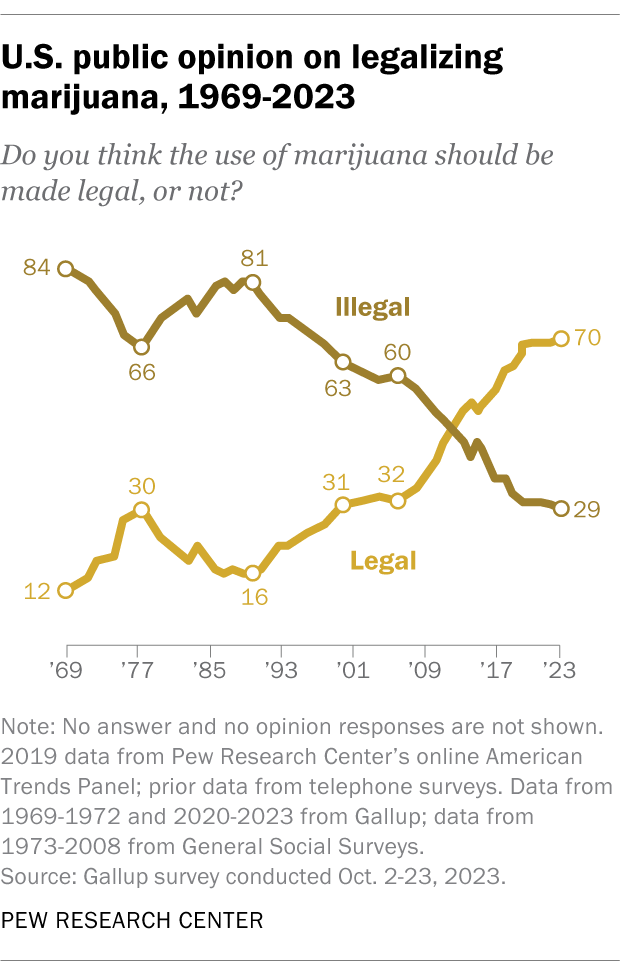
The evolution of public sentiment regarding marijuana legalization has been profound over the decades. Both Pew and Gallup surveys have documented a significant upward trend. For instance, Gallup’s 2023 poll indicated that 70% of American adults supported legalization—more than double the figure from 2000. This growing acceptance reflects broader societal changes in attitudes toward drug use and personal freedom.
Marijuana Usage Among Americans
According to the 2023 National Survey on Drug Use and Health, about 51% of U.S. adults reported having used marijuana at some point in their lives. However, the number of current users is much lower; only 23% of adults reported marijuana use in the past year, with 16% acknowledging usage in the last month.
Perceived Impacts of Legalization
Many Americans believe that legalizing recreational marijuana can bring economic growth and criminal justice improvements, though opinions diverge on the specifics:
- Economic Impact: As many as 52% of adults see legalizing recreational marijuana as beneficial for local economies, while just 17% view it negatively.
- Criminal Justice: Forty-two percent believe legalization will lead to a fairer criminal justice system, contrasting with 18% who think it would exacerbate issues of fairness.
- Safety and Drug Use: While 21% feel legalization would enhance community safety, 34% believe it would make communities less safe. Similarly, perspectives on its effect on the use of other drugs remain divided.
Supporting Criminal Justice Reform
Reflecting on the consequences of past marijuana policies, a significant majority of Americans support easing penalties for those with marijuana convictions. A 2021 survey revealed that two-thirds of U.S. adults favored releasing individuals imprisoned solely for marijuana-related offenses. Younger adults, Democrats, and Black Americans particularly lean toward supporting both release from prison and expunging criminal records related to marijuana.
State-Level Legalization Trends
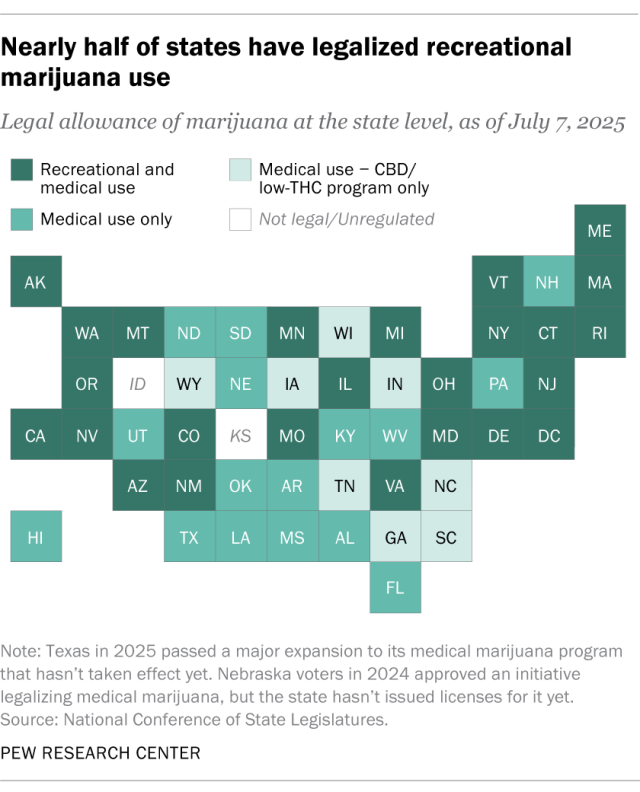
As of 2024, 24 states and the District of Columbia permit adults to possess small amounts of marijuana for both recreational and medical use. Coincidentally, another 24 states allow medical marijuana access but not recreational. The landscape continues to evolve, with notable legislation and ballot initiatives influencing state-level decisions.
Access to Cannabis Dispensaries
As of 2024, about 79% of Americans reside in counties with at least one cannabis dispensary. With nearly 15,000 dispensaries nationwide, most are located in states where recreational use is legally permitted. States like California, Florida, and Michigan house a significant number of these dispensaries, reflecting the growing accessibility of cannabis products to consumers.
The considerable support for marijuana legalization and evolving state laws indicate a transformative period in the U.S. regarding cannabis policy, mirroring shifts in cultural and societal attitudes.