

Singapore Laws Every Traveler Should Know
If the simple act of chewing gum can get you into trouble, what else do travelers need to know about Singapore laws? Welcome to Singapore, one of the world’s safest and wealthiest countries, where cleanliness and order reign supreme. However, behind this polished facade lies a complex web of laws that can catch visitors off-guard. Here are key regulations to keep in mind to ensure a smooth trip in this vibrant city-state.
Drug Laws Are Very Harsh
One thing travelers should understand is the serious stance Singapore takes against drugs. Unlike some neighboring countries that have loosened their drug laws recently, such as Thailand, Singapore’s laws remain extremely strict. The penalties for drug trafficking are severe, with the death penalty applicable for trafficking more than 500 grams of cannabis, 15 grams of heroin, 30 grams of cocaine, or 250 grams of methamphetamine.
This isn’t just theoretical—more than a dozen individuals were on death row for drug offenses as recently as 2003. Even minor possession can lead to significant prison time, making it clear: avoid all controlled substances when in Singapore.
Littering Fines Are Huge
Singapore’s cleanliness is nothing short of impressive, earning it a reputation as one of the cleanest countries globally. The citizens take great pride in maintaining this pristine environment, and the government supports this ethos with strict laws against littering.
First-time offenders can be fined up to SGD 1,000 (about USD 730), with subsequent fines escalating to SGD 2,000 and SGD 5,000 for second and third offenses, respectively. So, if you have the impulse to toss a candy wrapper or a cigarette butt, think twice!
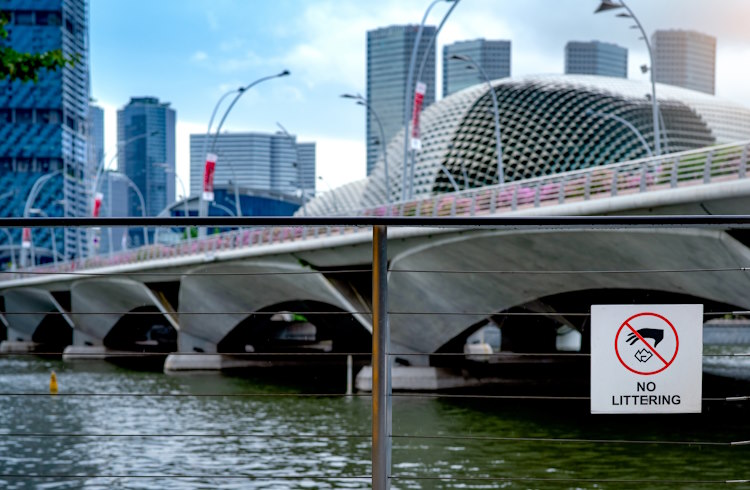
A no-littering sign in downtown Singapore. Image credit: Getty Images / Fahroni
Yes, Chewing Gum Is Banned
It may sound unbelievable, but chewing gum is banned in Singapore. An extension of the country’s litter laws, the ban applies to both the sale and possession of chewing gum. While it’s not available in stores, the prohibition goes even further—you’re not legally permitted to bring it into the country either.
If caught chewing gum, you might face fines starting at SGD 500. On a larger scale, selling or importing gum can lead to fines of up to SGD 100,000 for a first offense. This law was enacted in 1991 in response to the mess created by discarded gum all over public transport.
Overstaying Your VISA Is a Serious Offense
In various countries across Southeast Asia, overstaying a visa is often seen as a minor infraction. Unfortunately, that’s not the case in Singapore.
Tourists from many countries, including the US, Europe, and Australia, are permitted to stay for up to 90 days without a visa. However, staying beyond that period, even by a day, can lead to a fine of up to SGD 4,000 or imprisonment for up to six months. If you overstay for longer than 90 days, the penalties increase significantly, including the possibility of caning. Remember, all overstayers will be deported and barred from re-entering.
Homosexuality Is No Longer Illegal
In a significant shift, Singapore decriminalized same-sex relations in 2022, a major move towards LGBTQ+ rights. The law that once prohibited “gross indecency” between males has been officially removed, marking progress in the fight for equality.
Though strides have been made, same-sex marriage remains illegal, highlighting a complex social landscape. It’s wise for travelers to remain informed about local attitudes and sensitivities.
Protests Are a Legal Quagmire
While political activism might not be part of your vacation plan, it is vital to understand the risks associated with protests in Singapore. The country’s Public Order Act restricts freedom of speech and peaceful assembly, meaning most public demonstrations are illegal without special police permits.
Acquiring such permits is often challenging, making protests a rarity in Singapore. If you happen upon one, it’s best to steer clear to avoid legal repercussions.
Traveling in Singapore can be an incredibly rewarding experience, but understanding and respecting local laws can pave the way for a trouble-free visit. Stay informed, stay safe, and enjoy the unique charm and vibrancy that this city-state has to offer!